Why Google Added the ‘E’ to EEAT (And Why It Changes Everything)
Here’s a number worth paying attention to: according to Google’s own quality rater guidelines updates, content demonstrating first-hand experience now carries significantly more weight in ranking assessments than it did just two years ago. That’s not a small adjustment. Understanding EEAT Google search quality signals has become one of the most important things a product company can do to protect and grow organic traffic.
For years, Google evaluated content quality using EAT: Expertise, Authoritativeness, and Trust. It worked reasonably well when most content was written by humans with genuine perspectives. Then AI-generated content flooded the internet, and Google had a problem.
Technically proficient articles with zero lived experience were ranking for competitive queries. The quality of information on the surface looked fine, but there was no real human behind it.
So in late 2022, Google added a fourth pillar: Experience. And in 2026, it’s not theoretical anymore. Sites that can demonstrate first-hand knowledge are outranking sites that can’t, even when the competing content is technically well-optimized.
If you’re building a product and relying on organic traffic, this shift matters more than almost any other ranking factor update in recent memory. The bar for ranking has gone up, and it’s worth understanding exactly what that means for your content strategy.
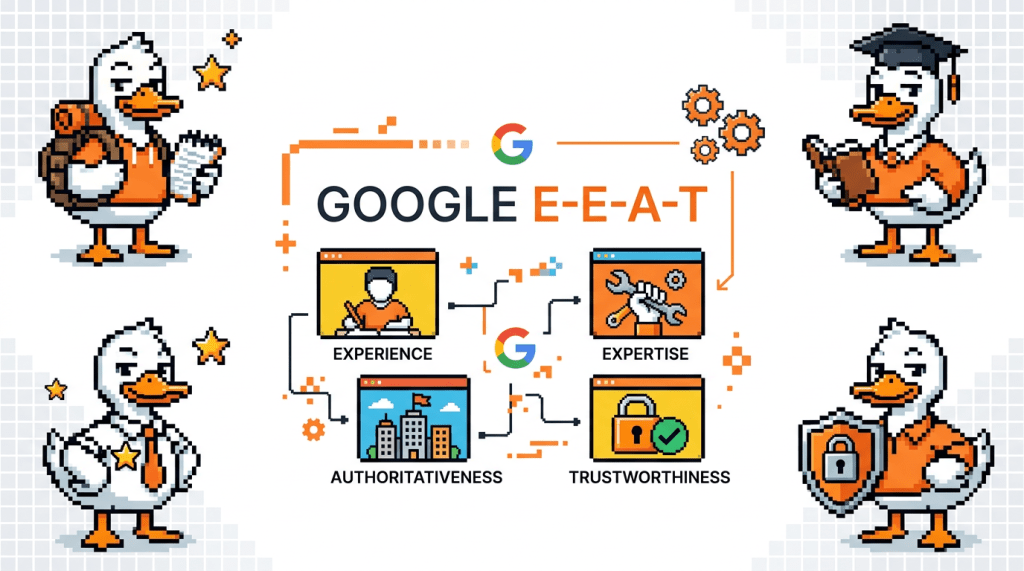
Breaking Down the EEAT Google Search Framework: What Each Pillar Really Means
Let’s skip the textbook definitions and talk about what these actually look like in practice.
Experience
This is the newest pillar and honestly the most interesting one. Google wants to see that the person writing about a topic has actually lived it, not just researched it.
A founder writing about how they reduced customer churn from 18% to 6% has Experience. A content writer who read three case studies and synthesized them does not.
The difference shows up in the specificity of the writing, the edge cases mentioned, the things that didn’t work, and the nuance that only comes from doing something yourself.
For product teams, this is actually a competitive advantage. You’ve built something. You’ve made mistakes. You have opinions formed through real work. That’s exactly what Google is trying to surface.
Expertise
Expertise is about demonstrable skill and credibility in your specific domain. It’s different from Experience because it’s more about depth of knowledge over time, not just a single lived moment.
A SaaS founder who has written 40 in-depth posts about go-to-market strategy, pricing models, and retention metrics has built expertise signals. Someone who posts occasionally across 15 unrelated topics has not. Consistency in your subject matter is what builds this signal over time.
Authoritativeness
This one is more external. It’s not what you say about yourself. It’s what others say about you.
Backlinks from reputable sources, brand mentions in industry publications, citations from other credible websites, and even podcast appearances or conference talks feed into how Google perceives your authority.
Think of it as your reputation signal. You can write the most thorough, well-sourced content in your niche, but if no one else is referencing your work, Google treats you as relatively unknown.
Trust
Trust is the foundation the other three sit on. It includes things like site security (HTTPS), transparent author information, accurate and up-to-date content, clear ownership of your domain, and organizational credentials being visible on the page.
A homepage with no team page, no contact info, and no company background has weak trust signals regardless of content quality. A site with schema markup, verified authorship, and consistent factual accuracy starts with a meaningful advantage.
Now that you know what each pillar means, let’s get into what Google is actually measuring underneath the surface.
EEAT Google Search Signals That Actually Move Rankings
Knowing the four pillars is useful. Knowing what Google actually detects is where it gets actionable.
Here’s what’s actively being evaluated:
- Author bylines with real credentials. A byline that links to an author page with a bio, LinkedIn profile, published work, and relevant experience matters. Anonymous or generic content does not score well here.
- Topical authority. This is about depth over breadth. If your site has 50 posts all tightly focused on SaaS growth metrics, Google starts to recognize you as a legitimate source on that topic. If those 50 posts cover everything from productivity hacks to travel tips, the signal is scattered and weak.
- Backlink quality. Not just quantity. A single backlink from a respected industry publication does more for your Authoritativeness than 50 links from irrelevant directories.
- Domain history and age. Older domains with consistent publishing histories tend to carry more baseline trust. New domains can build it, but it takes time and consistent output.
- Technical compliance. Page speed, mobile usability, structured data, HTTPS, crawlability. These aren’t exciting, but they’re the baseline that Trust signals depend on.
- User satisfaction metrics. CTR from search results, time on page, and bounce behavior all feed into how Google interprets whether your content actually satisfied the search intent.
- Schema markup. Implementing author schema, organization schema, and article schema helps Google understand who created the content and what entity is responsible for it.
The good news is that several of these signals compound over time. Consistent topical content creation, steady backlink development, and ongoing technical maintenance all reinforce each other.
That’s exactly where AI-powered content automation starts to make a lot of sense for product teams who can’t afford to manually manage all of this.
Common EEAT Google Search Mistakes That Kill Your Rankings
Most teams aren’t failing because they don’t care about content quality. They’re failing because of patterns that are easy to fall into, especially when you’re moving fast.
- Thin content with no first-hand perspective. A 1,200-word post about "how to reduce SaaS churn" that’s basically a list of generic tips sourced from other articles has no Experience signal. Google can tell. So can readers.
- Topic sprawl. Publishing about product-led growth one week, cold email tactics the next, and then a random post about team culture breaks your topical authority signal. Pick a lane and go deep in it.
- Weak or missing author credentials. If your blog posts don’t have author bylines, or the bylines link to an empty author page, you’re leaving Expertise signals on the table. Google needs to understand who is writing and why they’re qualified.
- Outdated content left to rot. A post that was accurate in 2023 but hasn’t been updated in three years signals low Trust. Regular content refreshes matter more than most teams realize.
- No visible organizational signals. If your site has no About page, no team information, and no clear company credentials, the Trust pillar is essentially missing. This is especially damaging for YMYL (your money or your life) adjacent topics like finance, health, or software security.
- Mismatched expertise. A developer tool company publishing content about parenting or lifestyle topics creates a confusing authority signal. Your content should reinforce what your domain is authoritative about.
These aren’t edge cases. They’re the most common reasons product-focused companies with solid products and smart teams struggle to rank despite publishing regularly.
Once you’ve identified the gaps, the next question is how to fix them without burning out your team.
How to Build EEAT Google Search Authority Without Manual SEO Work
Here’s the honest reality for most product teams: you know EEAT matters, but you also have a roadmap to ship, customers to support, and a business to run. Manually managing all four pillars consistently is genuinely hard.
The way teams are solving this in 2026 is by letting AI agents handle the repeatable parts of EEAT-building on autopilot.
Consider what consistent EEAT-building actually requires:
- Regular, topically focused content that demonstrates expertise in your niche (Content)
- Backlink development from relevant, reputable sources (Authority)
- Technical audits and fixes that maintain trust signals (Trust)
- Interconnected content that builds topical depth over time (Experience)
Each of these compounds. A Content Worker that continuously creates relevant, thematically connected articles builds topical authority over months without you touching a brief. An Outreach Worker that develops backlinks from reputable industry sites steadily strengthens your Authority signal. A Technical Worker that runs ongoing audits and flags issues keeps your Trust signals clean without requiring manual reviews.
The compounding effect is real. One good piece of content doesn’t move the needle much. But 60 interconnected articles published over six months, supported by backlinks and clean technical health, starts to shift how Google sees your domain.
And when that work is happening 24/7 without your team needing to manage it, the math changes significantly. You stay focused on the product. The EEAT signals keep building in the background.
Your Next Move: Run This EEAT Google Search Audit Today
EEAT isn’t optional in 2026. It’s the framework Google uses to decide who deserves to rank, and it’s actively affecting results for product companies trying to grow organic traffic.
Run through this quick audit right now:
- Do your blog posts have real author bylines with visible credentials?
- Is your content focused tightly on your core domain, or scattered across topics?
- When did you last build a meaningful backlink from a reputable source?
- Is your technical SEO clean (speed, mobile, schema, HTTPS)?
- Have you updated any older posts that may now be outdated?
If several of those answers are uncomfortable, the foundational work is clear. The good news is that when you build EEAT the right way, it compounds. Every credible article, every quality backlink, every clean technical audit makes the next one more effective.
Ready to put EEAT-building on autopilot? Grab a demo with Duqky and we’ll walk you through exactly how our autonomous agents handle this work for product teams like yours.
 Site Title
Leave a comment