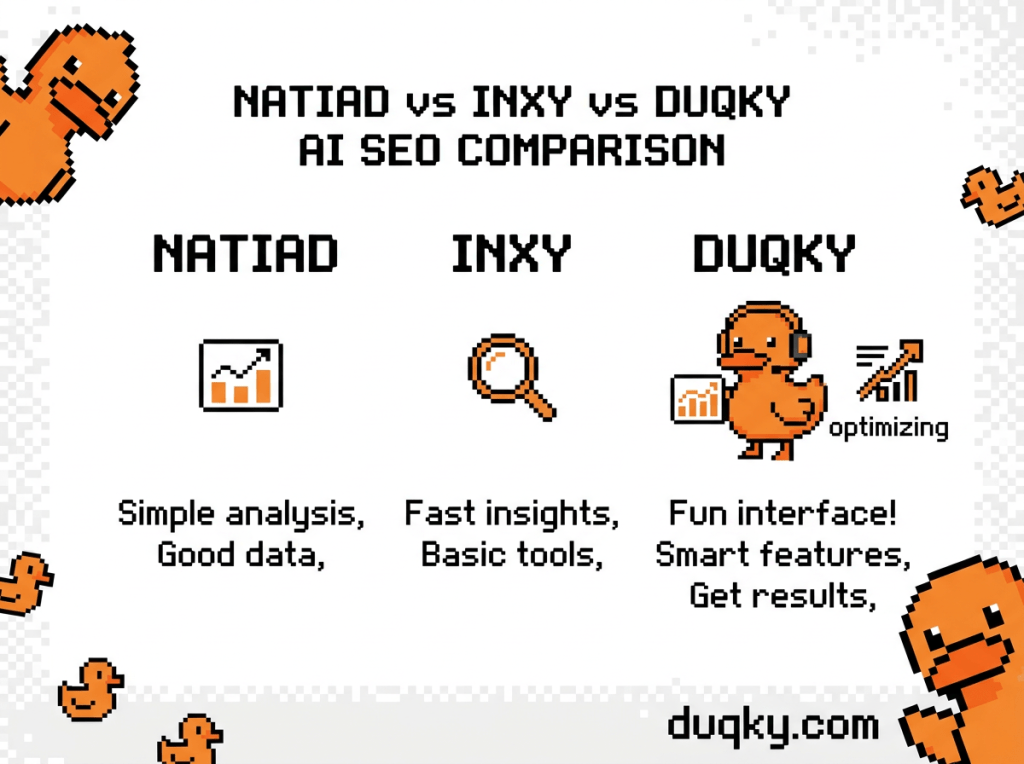
If you’re a founder trying to grow organic traffic without hiring an SEO team, you’ve probably stumbled across a handful of AI SEO tools promising to do the work for you. Three names that keep coming up in 2026: Natiad, Inxy, and Duqky. All three claim to automate SEO, all three use AI, and all three are genuinely different in how they work, who they’re built for, and how much they actually do on autopilot.
This natiad vs inxy vs duqky ai seo comparison breaks down each platform honestly so you can figure out which one fits your situation. A lot of teams arrive at this decision after spending months with traditional SEO tools like Ahrefs, Semrush, or Surfer SEO and realizing they still need someone to actually execute the strategy. These three platforms take a different approach: the AI handles the execution, not just the research and analysis. That shift matters a lot as Google’s RankBrain and AI Overviews continue reshaping how search engine rankings work.
What Each Tool Actually Does
Before doing a proper side-by-side SEO comparison, it helps to understand the core promise of each platform.
Natiad pitches itself as an SEO agent that runs your SEO on autopilot. It focuses on getting your product to rank on Google and show up in ChatGPT recommendations through automated blog posts. The positioning is squarely aimed at indie founders and small teams who want to stop worrying about SEO and just build.
Inxy takes a broader approach. It’s positioning itself as an autonomous stack covering SEO, AEO (Answer Engine Optimization), GEO (Generative Engine Optimization), and LLMO (Large Language Model Optimization) for ecommerce and SaaS. Three content engines work together: a Content Engine, an SEO Engine, and an AI Engine. It’s more of a full-funnel content and visibility platform.
Duqky focuses on autonomous AI agents that handle content creation, link building, and technical SEO audits continuously, 24/7. The agents are called the Content Worker, Outreach Worker, and Technical Worker. The pitch is zero manual work: you connect your site, and the agents run on autopilot while you focus on your product.
Content Creation and Optimization
Content is where the rubber meets the road for any AI SEO tool. Here’s how each one stacks up on content creation and optimization.
Natiad:
- Generates blog posts automatically on a publishing rhythm
- Focuses on matching search intent and building topical coverage over time
- Simple and focused, gets the job done for basic content needs
- Consistent publishing that slowly expands your keyword footprint
Inxy:
- Extracts your brand DNA to write in your voice
- Supports 30+ content archetypes (guides, comparisons, FAQs, product copy)
- Auto-publishes to Shopify or lets you review before going live
- Strong brand voice consistency across high content volumes
Duqky:
- Handles blog posts and content creation continuously
- Targets keyword clusters that matter for your niche
- Content compounds the longer it runs, with the organic traffic curve getting more interesting at month 3, 6, and beyond
- Content feeds directly into link building and technical work running in parallel
For teams that previously used tools like Surfer SEO or Clearscope to manually brief and optimize content, these platforms largely fold that step into the automation. Content optimization happens as part of the publishing process rather than as a separate workflow.
For pure content volume and variety, Inxy has the most features. For simplicity and consistency, Natiad and Duqky are closer. Duqky’s advantage is that content doesn’t run in isolation: it’s connected to outreach and technical fixes at the same time.
Keyword Research and Competitor Analysis
Keyword research and competitor analysis are where teams often spend the most time in traditional SEO workflows: pulling reports from Ahrefs or Semrush, finding competitor content gaps, building briefs in Frase or Clearscope. Here’s how these platforms handle that side of the work.
Natiad focuses on topical coverage rather than granular keyword research. It identifies content gaps and builds around them, but it doesn’t give you the detailed keyword data you’d pull manually from a dedicated research tool.
Inxy includes keyword strategy as part of its SEO Engine, with competitor analysis built into how it surfaces content opportunities, especially for ecommerce. More visibility into the competitive landscape than Natiad, though still within the context of automated content rather than raw research output.
Duqky’s Content Worker continuously targets keyword clusters across semantically related terms, building coverage rather than chasing individual rankings. For teams that want keyword research handled automatically instead of running weekly reports from Ahrefs or Semrush, this removes a meaningful chunk of manual work. It won’t replace a dedicated competitive analysis workflow for enterprise teams, but for most early-stage and growth-stage companies, the coverage is solid.
The broader point: these platforms are execution tools, not research tools. They’re most powerful when you want the work done rather than another dashboard telling you what to do.
Link Building and Domain Authority
This is where the comparison gets interesting because most AI SEO tools skip link building entirely. It’s hard, it’s manual, and it doesn’t lend itself to automation easily.
Natiad doesn’t appear to include active link building as part of its offering. The focus is on content and rankings through topical coverage.
Inxy has an SEO Engine that handles backlink strategy as part of its full-funnel approach, but the depth of the outreach automation isn’t fully clear from public information.
Duqky built an Outreach Worker specifically for link building. It identifies link opportunities, runs outreach, and works on building domain authority continuously. This matters a lot because backlinks are still one of the heaviest-weighted ranking signals for Google in 2026. Content without backlinks only goes so far, especially in competitive niches. If domain authority growth is a priority for you, this is a real differentiator.
Technical SEO
Most founders ignore technical SEO until something breaks. Crawl errors, slow pages, indexing issues, schema problems: these things quietly tank your search engine rankings even when your content is solid.
Natiad focuses primarily on the content and visibility side. Technical SEO auditing isn’t the core of what it does.
Inxy includes technical SEO as part of its broader engine, with a GEO audit component for visibility across AI search platforms. This is interesting as AI search optimization becomes more relevant.
Duqky’s Technical Worker runs continuous audits, catches issues, and flags or fixes them without you having to manually run tools like Screaming Frog or check Google Search Console every week. The idea is that technical debt doesn’t pile up because there’s always an agent watching for it.
AI Search and ChatGPT Visibility
This is the new frontier in 2026. With AI search nearing 1 billion users globally, ranking in Google is no longer the only game in town. Google’s AI Overviews, ChatGPT, Perplexity, Gemini, and Claude all generate answers from across the web, and getting cited in those responses matters as much as traditional search engine rankings for many businesses. The shift toward conversational search queries means content needs to be structured for both keyword-based discovery and natural language answers. Check out our guide on how to write blog posts for LLMs if you want to dig into that topic specifically.
Natiad explicitly targets ChatGPT visibility alongside Google rankings, which shows they’re thinking about the shift toward AI-powered search. Their content strategy is built with LLM recommendations in mind.
Inxy goes deepest on this with dedicated LLMO and AEO coverage. If AI citations and brand visibility in AI-generated answers are your main concern, Inxy has built more infrastructure around this specifically than the others.
Duqky takes the position that well-structured, topically authoritative content combined with strong backlinks naturally earns AI citations over time. The focus is on building the fundamentals that both Google and AI engines reward, rather than gaming specific algorithms.
SERP Tracking and Performance Reporting
Knowing whether your SEO is actually working means tracking search engine rankings, organic traffic growth, and visibility over time. Here’s how each tool handles performance reporting.
- Natiad provides basic ranking visibility so you can see whether the content it’s publishing is moving the needle on search.
- Inxy goes deeper on reporting, with dashboards covering content performance, keyword ranking trends, and AI citation tracking across platforms.
- Duqky tracks ranking performance, organic traffic growth, and technical health across all three agents. You can check in when you want to, but you don’t have to monitor it constantly for it to keep working. SERP tracking is built into the reporting layer rather than requiring separate subscriptions to tools like Pro Rank Tracker or weekly manual Google Search Console checks.
For teams transitioning away from manual tracking setups in Ahrefs or Semrush, the built-in reporting in these platforms covers the core performance data without adding another tool to the stack.
Who Each Tool Is Built For
Here’s a quick breakdown of who each platform actually suits best:
Natiad is good for:
- Solo founders and indie hackers
- Teams who want simple, no-frills SEO automation
- Products focused on ranking and getting mentioned by AI tools
- Low-budget situations where simplicity wins
Inxy is good for:
- Ecommerce stores and SaaS companies with content-heavy needs
- Teams who want brand voice consistency across lots of content types
- Businesses prioritizing AI search citations and GEO optimization
- Companies who want a full content funnel (blogs, FAQs, product copy)
Duqky is good for:
- Product-focused founders who want 100% hands-off SEO
- Teams that need content, link building, and technical SEO running together
- Businesses where domain authority growth is part of the long-term strategy
- Anyone tired of juggling separate tools for content, outreach, and audits
Side-by-Side Feature Comparison
| Feature | Natiad | Inxy | Duqky |
|---|---|---|---|
| Automated content | Yes | Yes (30+ archetypes) | Yes |
| Content optimization | Basic | Advanced | Yes |
| Keyword research | Basic | Yes | Yes (automated clusters) |
| Competitor analysis | No | Partial | Partial |
| Link building | No | Partial | Yes (Outreach Worker) |
| Technical SEO | No | Partial | Yes (Technical Worker) |
| SERP tracking | Basic | Yes | Yes |
| AI search optimization | Yes | Yes (LLMO/AEO/GEO) | Yes |
| AI Overviews optimization | Partial | Yes | Yes |
| Brand voice matching | Basic | Advanced | Yes |
| 24/7 autonomous agents | Partial | Partial | Yes |
| Ecommerce focus | No | Yes | No |
| Pricing transparency | Basic | Not public | Straightforward |
The Real Difference: Depth of Automation
The most important question isn’t which tool has the most features, it’s how much you actually have to do yourself once you’re set up.
Natiad is simple by design. You connect your site, it starts publishing, and the scope stays deliberately narrow. Low friction, limited range.
Inxy has a lot of capability but also involves more setup, brand onboarding, and decisions about what content to publish and when. The output is higher quality and more varied, but it’s not fully set-and-forget.
Duqky is built around the idea that you connect your site and the agents handle everything else: content goes out, outreach runs, technical issues get flagged. The value compounds over time as the agents build topical authority and domain authority simultaneously. If you’ve looked at SaaS SEO cost comparisons for 2026, you’ll know how expensive traditional SEO agencies are. The pitch with Duqky is that you get agency-level output without agency-level overhead or management time.
The other comparison worth reading if you’re in this space: Natiad vs SEOBot vs Duqky goes deeper on a few of these platforms.
Frequently Asked Questions
Which AI SEO Tool Is Best for a Small SaaS Startup?
For most small SaaS teams, Duqky or Natiad make the most sense. Natiad is simpler with a low barrier to entry. Duqky gives you more coverage (content plus link building plus technical SEO) without requiring more of your time. If your team is stretched thin and you want one tool running everything, Duqky is the stronger fit.
How Do These Platforms Compare to Traditional SEO Tools Like Ahrefs and Semrush?
Ahrefs and Semrush are research and analysis tools. They show you what to do but don’t do it for you. Natiad, Inxy, and Duqky are execution platforms that handle the doing. Most teams find them complementary rather than competing directly. You might still use Ahrefs to monitor competitive performance at a high level, but you’d use Duqky to actually publish content and build links. For lean teams that want one system handling the bulk of SEO execution, these AI platforms cover enough of the keyword research and content optimization layer to reduce or remove Semrush and Surfer SEO from the daily workflow entirely.
Does Inxy Work for Non-Ecommerce Businesses?
Inxy targets both ecommerce and SaaS, but a lot of its features (Shopify auto-publish, product copy archetypes) are clearly built with ecommerce in mind. SaaS teams can use it, but some of the tooling may feel like overkill or misaligned depending on your content needs.
How Long Before AI SEO Tools Show Results?
Most AI SEO tools, including these three, start showing meaningful results between 60 and 120 days. Organic traffic from SEO compounds over time rather than spiking immediately. The more consistently content publishes and the faster domain authority builds, the sooner the curve starts to move.
Can These Tools Replace a Full SEO Team?
For early-stage and growth-stage teams without a dedicated SEO hire, yes, tools like these can cover most of what a junior-to-mid SEO would handle. Where a human team still adds value is in strategy, competitive analysis, and big-picture content planning. But for execution, the automation is genuinely solid in 2026.
Which One Should You Pick?
If you want simple and cheap: Natiad works.
If you want the deepest AI search visibility stack with the most content variety: Inxy is worth exploring, especially for ecommerce.
If you want true autopilot across content, link building, and technical SEO, all running together without managing three separate tools or a spreadsheet full of tasks: Duqky is built for that. Connect your site, let the agents run, and check back when the traffic reports start looking good.
The best SEO tool is the one that actually keeps running after week two. For most product teams, that means automation has to be real, not just a dashboard that still needs you to push all the buttons. Start your free trial with Duqky and see how the agents work for your site.
 Site Title
Leave a comment